Saturday, 10 July 2010

Question Time

This Rwandan forest I keep going on about is a pretty rich and diverse place and people have lived a good life off it for a long time. The soil is great for growing crops and under that there’s lots of gold waiting to be claimed…. there’s a different kind of wood for every purpose you could need, medicines for all ailments and, if you’re hungry, pigs, deer and chickens roaming about. There’s also some of the best honey going and a bit of fruit and veg if you’re so inclined. These things can bring in a decent income.


I remember when all this was fields....I mean forest.


Unfortunately word gets out and when tens of thousands of people are digging, chopping and trapping, the forest starts shrinking. And it’s really in everyone’s interests to keep it there for the rain and the water (and of course all that lovely carbon). But! Imagine you were living the good life by the forest on your nice bit of land and all of a sudden some fella kicked you off and said “this has been made a National Park - don’t come back or I’ll arrest you or shoot you….” - you’d be a little aggrieved. This reality is fresh in the minds of people here and understandably relations with the man have not always been good.


The alternative life you have now involves growing your food on thin, poor soil on steep slopes and your only real work options are seasonal farm labour earning you around 50p a day….50p a day……or taking a risky option of travelling away to dig for gold for a little over £1 a day, when you can get the work. That makes it tough to get a foot on the ladder, tough to plan ahead, tough to feed your family.


Cunning minds have realised that helping all the people that live in the 50+ villages next to the forest actually helps the forest and the government is putting the tourists’ $$$ back into communities, with health centres, schools and goats popping up hither and thither.


One other fine option for a win-win is payments for environmental services (a PES scheme). This one, set up by clever folks in the university in Norwich, involves giving money to every household in a village (and an agreed % to community projects) in return for meeting targets for reduced numbers of snares, trees cut and forest paths made as well as for planting trees in the village and working together to guard crops from the cheeky (and slightly menacing) baboons and other beasties. And to spread the word and monitor this you hire local people.


So! Joseph (researcher/Country Director), Solange (University of Rwanda student) and myself (layabout) are heading to villages and going door to door to see what they think of the scheme and what effect it’s having on the way they do things. First on the list were Murwa (with the scheme) and Kiyabo (without the scheme to compare). They are wedged between Nyungwe forest and the Burundi border - fairly cut-off from the rest of Rwanda.


The presence of large mountains, lack of roads and no power mean this requires some planning……


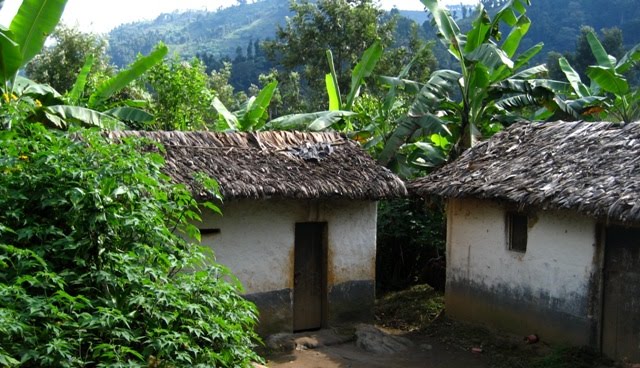
The poorer houses are made of a bit of wood, a lot of mud and loads of banana leaves.


A step up from this you have bricks and metal sheets.
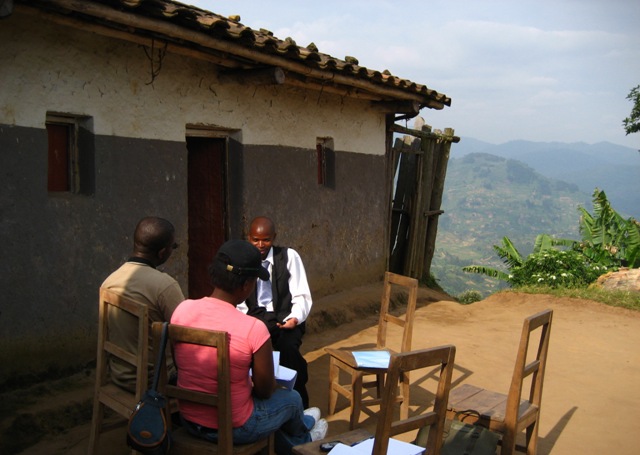

If you’re doing well for yourself you can get some roof tiles. This is the chief of the village being interviewed and looking smart because 4th July is Liberation Day (from the Belgians).


Everyone gathered in the village to listen to the President's speech on the radio.


And very much unable to merge with the crowd, I was quickly shuffled to a seat facing everyone, alongside church, military and political figures as goats and small children passed by.


Maybe someone knew the President's speech would be delayed and suddenly myself and Joseph were asked to make impromptu speeches to fill in some of the time. I'm not sure any of the gags about growing pineapples in Inverness translated very well......


Village of Kiyabo in the middle, forest on the left, Burundi on the right.


Which one is number 27?


Not the person to ask directions.


There's someone lurking behind every bush. Admittedly this one is my boss though....


Farming is on some serious slopes here and it’s not unusual for it all to slip away.


Kids following me through a gold mine in Kiyabo.


Murwa perched on the hill (bottom right). The Koko River flowing through the valley marks the border with Burundi.


Joseph talking to community monitors.


Kids who should be looking after goats but have been distracted by a scally.


Getting back up the hill just before the fruit bats come out and it gets pitch black...for once.


Is this a small cow or camera trickery? I don’t think it can get out. Livestock is the main ambition people have, to provide much needed fertiliser and to sell on any young.


Mantis on a banana flower.


Pots warming up and dinner trying to escape in the back corner!


Steaming fufu – cassava bread. One is supposed to slice meaningfully with forefinger.


And back in Butare with my neighbour Gael, trying to improve my language skills.

Monday, 21 June 2010

Life on the edge of the forest – the village of Banda

It’s easy to get swept away by tourists’ tales of gorilla tracking while staying in comfy lodges serving chicken and chips, but I decided to head to the village of Banda to camp for a few nights at a community tourism project (which is conveniently much cheaper) and get a taste of real life around the forest. The walk down from Uwinka, in the middle of Nyungwe National Park, was a steep one, quickly descending 600m from an altitude of 2,450m.


Looking down on Banda village


This community lives right on the edge of Nyungwe and has depended on it for fuel, building materials, medicine and for food. There are now efforts to stem this dependence and provide for these uses by means other than reducing the size of the remaining forest.


Camp site on edge of forest


As I struggled down with my wee rucksack full of guide books, a line of men carrying 5 gallon cans on their heads passed us….. going upwards. Making a living here involves hard work, very hard work. What was in the cans was the traditionally made banana beer, which will sell at the top of the hill and an hour bus ride away for about 40p a pint. They’re not shy of a banana or two in Banda and the brewing process, after ripening, squeezing and with the aid of some sorghum only takes two days (Cue banana montage).


Bananas from various angles


Village life is fascinating and once I laid eyes on Banda and the campsite I didn’t really care about birds and monkeys in the forest. The red soils are used for growing all manner of veggies including peas, sweet potatoes and of course bananas. But the soils get packed together and breaking them up for planting is a tough task.


Apparently I was fascinating too – every time you lift your head there’s a posse of little kids waiting to see what Umuzungu will do next


You know when you’ve been Umuzungu’d


Cesar, who helps run the project, took me round to see beekeepers, a traditional smithy, banana beer makers, the market and even the town’s micro-hydro project. These folks are partners in a co-op and they get a share of the profits afterwards so it all goes back into the community, and other goofy looking characters like me hopefully get a warm reception. Hopefully plenty more will come.


Brave young lad in tree next to traditional beehive


Cesar partaking in a refreshing banana beer at the local shop


Thatching roof on traditional house


Market square on market day


Market square on another day – beans drying in sun. 2 men are checking electoral register for upcoming election (betting man’s money is on Paul Kagame again).


Blacksmithery house – Smith wasn’t at home


Traditional medicine man’s house and garden – Doc wasn’t home either


Bees were at home


Jolly battery charging man was home at the hydro station. This is the only power the village has (funded by the Wildlife Conservation Society) and again involves quite a walk with a hefty weight. I’m sure it won’t be too many years before power and a decent road come to town. Who knows, then you might all be able to get a Banda banana beer. I can recommend it!

There are quite a lot of projects on the go in Banda. The local nursery school has been a big one. There are a lot of kids here, with about 2,000 of the 5,000 population being schoolies.


The new school ensures the poorest of these get a place. They’re all taught in English now and every five year old can say “Good morning teacher” (whatever time of day it is) and sing “Number one number one where are you, here I am here I am how do you do” very impressively (sadly video won’t load!).


The school has a milking cow to get some milk into the kids’ porridge and has a whole nursery of avocado trees ready to go (plant pots ingeniously made of banana leaves).


They get fruit off of them within 2 years and every child is already an expert tree climber for harvest time


Justin the proud nursery school headmaster outside his new school


There’s also an eco-lodge about to be built up on the hill by a US charity. With Edward Norton and Meryl Streep advertising it I can’t help but be a little sceptical about how eco (and how affordable) it might turn out to be……

Into the Jungle

After getting acclimatised to Rwandan life and with a little time before work begins, it was time to plunge into the forest. So I spent half a week inside Nyungwe Forest and the other half in the village of Banda, right on the edge of the National Park.


At around 1,000 sq km, and between 1,500 and 3,000m high, this is about the largest remaining montane forest in Africa. Over 1,000 plant species to be found, so many birds they couldn’t manage a pocket guide, gangs of monkeys including chimpanzees as well as leopards and other secretive mammals rarely seen. And many of these species don’t live anywhere else but Nyungwe. Buffalo and elephants have become extinct in the park just in the last 20 years and plans are afoot to bring them back.


Nyungwe is on the tourist route as many people come to track chimps on their way to see gorillas in north-west Rwanda but it’s very few people paying quite a lot of money and the busy-ish season is a short one between June and August. Despite it being a National Park, white people are still very much a novelty in the towns here. I never saw a single other person on any of the trails, apart from my obligatory guide, Claver.


On the edges of the park are a number of tea plantations, which are a good source of local employment and form a good buffer to stop baboons and other beasties from munching people’s crops. Rwandan tea is great, although most people choose to ruin it with 4 sugars and a mound of Nestle powdered milk – nasty stuff!

It’s an amazing forest to look at with a prehistoric feel to it - plants of all different shapes, from tree ferns and giant lobelias to huge trees like mahoganies, some covered in climbers and epiphytes.


The forest spreads south into Burundi and from the peaks you can see west to Lake Kivu and the Congolese border.


A lot of water flows out of this forest, feeding the rivers Congo to the west and the Nile flowing to the north-east, providing around 70% of the country’s supply on the way.


It’s a thick jungle in parts and there be many forest critters. Here are some of the less scary ones, including an orchid that is only known in the world from this one tree!


I saw chimps drumming posts, their poos, half eaten fruits, their nests up in the trees, marks where they’d tried to break into bee-hives for the honey (below) and logs they’d broken open for termites. I even heard them calling through the forest, but haven’t set eyes on them yet. The token monkey picture is a grey-cheeked mangabey in a slightly uncomfortable looking position.


I couldn’t believe how nice the forest is. I was prepared for the worst but it’s a fine temperature and hardly a mozzy to be seen, even down in Africa’s biggest peat swamp at Kamiranzovu. I have to say Scotland is pretty hard done by.